
HYROX Training Guide: HYROX Explained, Performance Metrics to Track, and What Cardio Zones to Train
HYROX is a fitness race that tests your endurance and your ability to maintain performance under fatigue.
Unlike traditional endurance events or strength competitions, HYROX requires athletes to repeatedly transition between running and functional movements. For HYROX, the biggest performance metric is your ability to maintain a high percentage of your aerobic capacity (V02max) while repeatedly producing strength under fatigue. HYROX is not won by having the strongest sled push or fastest 1K split alone — it is won by how quickly you recover between stations and how well you can hold your running pace after each functional movement.
Whether you are training for your first HYROX event, competing in doubles, or chasing a faster finish time, your preparation should include more than just running and workouts that “feel hard.”
A successful HYROX training plan requires a strategic combination of:
Aerobic conditioning
Strength development
Running efficiency
Functional movement capacity
High-intensity interval training
Recovery and injury prevention
At Wild Physical Therapy & Performance, I help HYROX athletes, runners, and hybrid athletes build the strength, resilience, and movement capacity needed to perform at their highest level while reducing injury risk.
What Is HYROX?
HYROX is a standardized fitness race that combines:
8 x 1 km runs
with
8 functional workout stations
The race format includes:
1 km Run
1,000m SkiErg
1 km Run
50 m Sled Push
1 km Run
50 m Sled Pull
1 km Run
80m Burpee Broad Jumps
1 km Run
1,000m Rowing
1 km Run
200m Farmers Carry
1 km Run
100m Sandbag Lunges
1 km Run
100 Wall Balls
The challenge is maintaining your running pace and movement quality while accumulating fatigue. For more information about the race, visit the official Hyrox website.
The Biggest Mistake HYROX Athletes Make
Focusing too much time training the stations and not enough time training the run.
HYROX demands a unique combination of running endurance, maximal strength, muscular endurance, and movement efficiency. The latest HYROX Sports Science Report emphasizes that running accounts for the largest proportion of race time, while efficient pacing and strength-endurance capacity are key performance differentiators. Rather than relying solely on high-intensity workouts, athletes should build a foundation with progressive strength training, aerobic development, and adequate recovery to maximize performance and reduce injury risk.
The best athletes build:
Aerobic capacity
Strength endurance
Running economy
Movement efficiency
Recovery capacity
The Most Important HYROX Performance Metrics
1. VO₂ Max: Your Aerobic Ceiling
VO₂ max measures your body’s ability to consume and use oxygen during exercise.
A higher VO₂ max allows you to:
Run faster at the same effort
Recover more quickly between stations
Delay fatigue
Maintain performance throughout the race
For HYROX athletes, VO₂ max provides the foundation needed to repeatedly perform 1 km runs while transitioning into demanding movements like:
Sled pushes
Sled pulls
Burpee broad jumps
Farmers carries
Wall balls
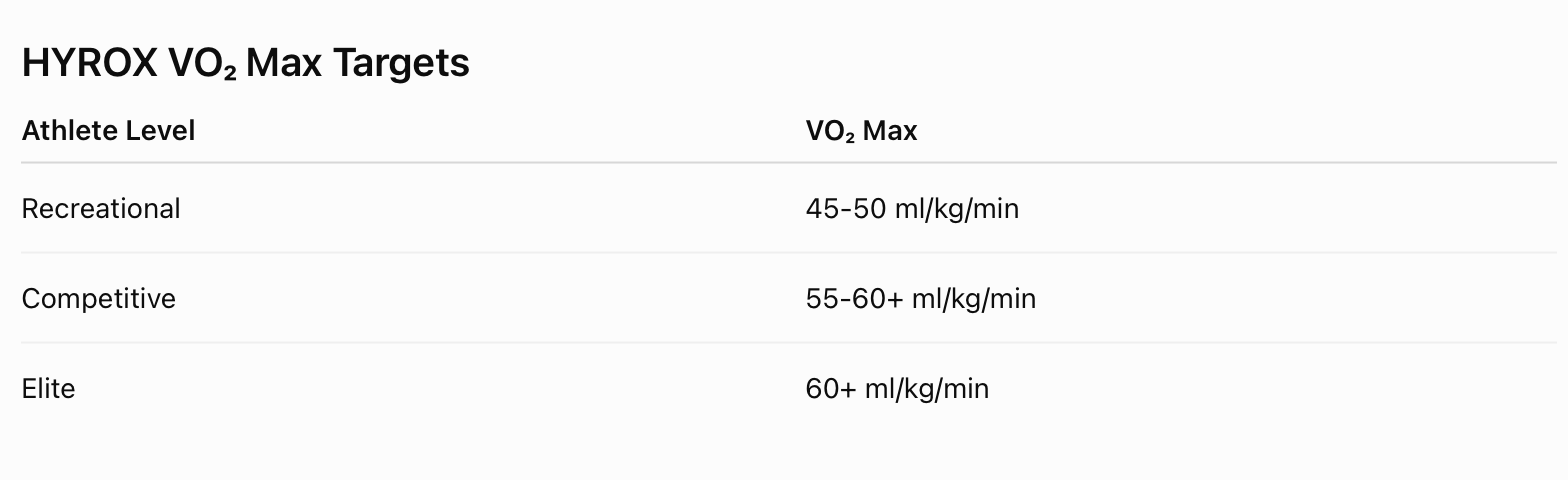
Typical ranges:
Recreational HYROX athlete: ~45-50 ml/kg/min
Competitive HYROX athlete: ~55-60+ ml/kg/min
Elite HYROX athletes: often 60+ ml/kg/min
While VO₂ max is important, it is not the only predictor of success.
HYROX rewards athletes who can use their aerobic capacity repeatedly under fatigue.
2. Lactate Threshold: The Ability to Sustain Race Pace
For many HYROX athletes, lactate threshold is one of the most important performance metrics.
Your lactate threshold represents the highest intensity you can sustain before fatigue accumulates rapidly.
A higher threshold allows you to:
Run faster without excessive fatigue
Recover faster after stations
Maintain consistent pacing throughout the race
HYROX is about finding the highest sustainable output and repeating it eight times.
A strong HYROX athlete can:
Run → Complete a station → Recover → Repeat
without a major decline in performance.
HYROX Performance Metrics to Track
Running Pace Under Fatigue
One of the best indicators of HYROX readiness is your ability to maintain your running pace after stations. A large drop indicates limited fatigue resistance.
Excellent HYROX fatigue resistance is <5% pace drop.
Example:
Fresh 1 km pace: 4:30/km (7:15/mile)
Fatigued 1 km pace: 4:40/km (7:31/mile)
This athlete is maintaining output very well.
Needs improvement is >10-15% pace drop
Example:
Fresh: 5:00/km (8:03/mile)
Fatigued: 5:45-6:00/km (9:15-9:40/mile)
This suggests the athlete may have:
Limited aerobic base
Poor lactate clearance
Insufficient strength endurance
Poor pacing strategy
Too much early intensity
2. Heart Rate Recovery
Your ability to recover between efforts is a major HYROX advantage.
Track:
How quickly your heart rate drops after hard intervals. Excellent Recovery is ≥30 bpm drop in 1 minute
Example:
Finish 1K interval: 180 bpm
After 1 minute recovery: 150 bpm or lower
Improved recovery allows you to repeatedly produce high-quality efforts.
3. Strength Drop Off Test: Measuring Your Ability to Perform Under Fatigue
HYROX is not a test of how strong you are for one repetition. It is a test of how well you can repeat high-quality efforts when your body is fatigued.
A key performance metric for HYROX athletes is strength drop-off — how much your power and movement quality decrease during repeated efforts.
A strong HYROX athlete should be able to maintain output even as fatigue accumulates.
How to Perform the Strength Drop-Off Test
Back Squat Repeatability Test
Equipment:
Barbell
Squat rack
Weight appropriate for your ability
Load:
Approximately 50-60% of your estimated 1RM
Protocol:
Complete 3 rounds:
60 seconds of maximum quality squats
60 seconds rest
Record:
Total reps each round
Technique quality
Heart rate response
How quickly you recover between efforts
Example Results
Athlete A: Excellent Fatigue Resistance
Load: 135 lb back squat
Round 1:
20 reps
Round 2:
19 reps
Round 3:
18 reps
Total: 57 reps
Strength drop-off: 10%
Interpretation:
Athlete maintains output well. Athlete demonstrates good lower-body endurance. Athlete can likely handle repeated HYROX stations without a major performance decline.
Athlete B: Limited Fatigue Resistance
Load: 135 lb back squat
Round 1:
22 reps
Round 2:
17 reps
Round 3:
13 reps
Total: 52 reps
Strength drop-off: 41%
Interpretation:
Athlete had a strong initial effort but poor repeatability. Athlete likely struggles maintaining output after fatigue accumulates. Athlete needs more focus on strength endurance and aerobic recovery.
How to Interpret Your Score

Excellent HYROX Readiness
<10% performance drop
You can maintain strength output despite fatigue.
Good HYROX Readiness
10-20% performance drop
Typical of a well-trained hybrid athlete.
Needs Improvement
>20% performance drop
May indicate:
Limited strength endurance
Poor pacing strategy
Insufficient aerobic base
Need for more fatigue-based training
4. VO₂ Max and Lactate Threshold
How Big Is Your Engine?
Your aerobic system is the foundation of HYROX performance.
Two important measurements:
VO₂ Max = Your Aerobic Ceiling
VO₂ max represents your body's ability to consume and use oxygen.
A higher VO₂ max allows you to:
Run faster
Recover quicker
Sustain higher workloads
Lactate Threshold = How Much of Your Engine You Can Sustain
Your lactate threshold represents the highest intensity you can maintain before fatigue rapidly increases.
For HYROX, this is extremely important because athletes spend much of the race near threshold.
Lactate Threshold Test Example: 30-Minute Threshold Run
Protocol:
Warm up 15 minutes
Run as hard as you can sustain evenly for 30 minutes
Track:
Average pace
Average heart rate during final 20 minutes
Example:
30-minute effort:
Pace: 7:00/mile
Threshold HR: 170 bpm
This means the athlete can sustain approximately 7:00/mile before rapid fatigue accumulation.
HYROX Goal:
Improve the pace you can maintain at the same heart rate.
Example:
Before:
8:00/mile @ 165 bpm
After training:
7:15/mile @ 165 bpm
Your engine improved.
5. Single-Leg Strength + Station Capacity
Can You Transfer Fitness Into Race Movements?
HYROX requires athletes to repeatedly produce force through unilateral and functional movements.
Single-leg strength impacts:
Running economy
Injury prevention
Lunges
Step-ups
Maintaining mechanics under fatigue
Single-Leg Strength Tests
1) Bulgarian Split Squat
Test:
5-8 controlled reps per leg
Target:
Intermediate:
25-50% bodyweight external load
Advanced:
50%+ bodyweight external load
Example:
150 lb athlete:
Advanced target:
~75 lb total external load for 5 reps each leg
2) Single-Leg Calf Raise
Important for:
Running durability
Sled pushing
Elastic strength
Targets:
Minimum: 25 quality reps per leg
Advanced: 35-40+ reps
HYROX Station Capacity Tests
1) Farmers Carry
Measures:
Grip endurance
Core stability
Strength under fatigue
Test:
Time it takes to complete 200m with race weight
Target:
1:30-3 mins
2) Wall Ball Test
Measures:
Squat endurance
Shoulder endurance
Ability to perform under fatigue
Targets:
Intermediate:
50 consecutive wall balls
Advanced:
75-100 consecutive wall balls
What Cardio Zone Should HYROX Athletes Train?
A common mistake is thinking every HYROX workout should feel like a race.
The best athletes build their engine through a combination of training zones.
Zone 2: The Foundation of HYROX Fitness
Approximately 70-80% of cardiovascular training
Zone 2 training builds your aerobic base and improves your ability to recover between hard efforts.
Intensity:
Approximately 60-70% of max heart rate
Conversational pace
You can speak in full sentences
Benefits:
Improves aerobic efficiency
Increases endurance
Improves recovery capacity
Allows you to tolerate more training volume
Examples:
Easy running
Cycling
Rowing
Incline walking
For HYROX athletes, Zone 2 is often the missing piece.
A bigger aerobic engine allows you to recover faster after:
Heavy sled work
Wall balls
Lunges
Carries
Zone 3: Tempo and Threshold Training
Approximately 10-20% of cardiovascular training
Zone 3 develops your ability to sustain challenging efforts.
Intensity:
Approximately 75-85% of max heart rate
Controlled but uncomfortable
Examples:
Tempo runs
Longer intervals
Sustained efforts
Workouts:
20-40 minute tempo run
3 x 10 minute threshold intervals
4 x 8 minute controlled hard efforts
This zone helps improve your ability to maintain race pace.
Zone 4-5: High Intensity Training
Approximately 5-10% of cardiovascular training
High-intensity work improves your ability to tolerate hard efforts and increases VO₂ max.
Examples:
400-800 meter intervals
SkiErg intervals
Sled pushes
HYROX race simulations
These workouts are valuable, but they create a high recovery demand.
More intensity does not always equal better results.
The goal is to strategically use intensity while maintaining consistency.
12 Week HYROX Training Plan Example
Phase 1: Foundation (Weeks 1-4)
Primary Goals
Build an aerobic base
Develop maximal strength
Improve movement quality
Increase tissue capacity
Prepare the body for higher training loads
This phase should make up approximately 70-80% easy aerobic training and 20-30% moderate to high intensity work.
Running (3-4 sessions/week)
Session 1: Long Run
60-90 minutes (advanced athletes may progress to 120 minutes)
Intensity:
Zone 2
Conversational pace
RPE 3-4/10
Session 2: Threshold Intervals
Choose one:
Option A
4 × 8 minutes
Zone 4
2-minute easy jog recovery
or
Option B
3 × 10 minutes
Zone 4
3-minute recovery
Goal:
Improve lactate threshold without excessive fatigue.
Session 3
45-60 minute Zone 2 run
Optional Session 4
30-45 minute recovery run
or
30-45 minute Zone 2 bike/row
Strength (2-3 sessions/week)
Focus on building strength.
Primary lifts:
Back Squat
Deadlift
Romanian Deadlift
Bench Press
Pull-ups
Overhead Press
Prescription:
3-5 sets
4-6 reps
RPE 7-8
Accessory work:
Bulgarian Split Squats
Single-leg RDL
Heavy calf raises
Copenhagen plank
Pallof press
Conditioning (1 session/week)
Examples:
5 rounds
500 m SkiErg
60 sec rest
OR
6 × 2 min Assault Bike
90 sec recovery
Keep intensity around RPE 7/10, not all-out.
Phase 2: Strength Endurance (Weeks 5-8)
Primary Goals
Convert strength into repeatable strength while maintaining your aerobic engine.
Training shifts toward longer intervals and hybrid workouts.
Running (3-4 sessions/week)
Long Run
75-120 minutes
Zone 2
Threshold Session
Choose one:
5 × 1 mile
Recovery:
2-3 minutes jog
OR
6 × 1 km
Recovery:
2 minutes jog
Run at approximately 10K pace or Zone 4.
Easy Run
45-60 minutes
Zone 2
Optional Recovery Run
30-45 minutes
Strength (2 sessions/week)
Main lifts:
3-4 sets
5-8 reps
Maintain strength while adding endurance.
Accessory work:
Higher volume:
Walking Lunges
Step-ups
Heavy Calf Raises
Farmers Carries
HYROX Conditioning (2 sessions/week)
Example 1
5 rounds
800 m Run
20 Wall Balls
20 Walking Lunges
Rest:
90 seconds
Goal:
Maintain consistent running pace throughout.
Example 2
4 rounds
500 m Row
50 m Farmers Carry
400 m Run
15 Burpee Broad Jumps
Goal:
Less than 10% pace decay from first to last round.
Phase 3: HYROX Race Preparation (Weeks 9-12+)
Primary Goals
Prepare specifically for race day by combining running with HYROX stations.
Training becomes increasingly race-specific.
Running (3-4 sessions/week)
Long Run
75-105 minutes
Zone 2
Maintain aerobic fitness without excessive fatigue.
Race Pace Intervals
Choose one:
8 × 1 km
Recovery:
90 seconds jog
Run at goal HYROX pace.
OR
4 × 2 km
Recovery:
3 minutes
Maintain even pacing.
Easy Run
40-60 minutes
Zone 2
Recovery Run
30-40 minutes
Strength (2 sessions/week)
Reduce lifting volume.
Maintain intensity.
Examples:
Back Squat
3 × 3-5
Deadlift
3 × 3-5
Split Squat
3 × 6
Heavy Calf Raises
3 × 8
Avoid training to failure.
HYROX Simulation (1 session/week)
Example
3 rounds
1 km Run
50 m Sled Push
1 km Run
50 m Sled Pull
1 km Run
80 m Burpee Broad Jumps
1 km Run
200 m Farmers Carry
1 km Run
100 m Sandbag Lunges
1 km Run
75 Wall Balls
Practice:
Race pacing
Station transitions
Nutrition
Hydration
Mental strategy
Key Performance Targets Reviewed
Running Pace Decay
Goal:
<5-10% slower from your first to last run interval during simulations.
Heart Rate Recovery
After a hard effort:
20-30+ bpm drop in the first minute.
Strength Drop-Off
During repeated squat testing:
<10-20% decline in repetitions.
Zone 2 Training
Aim for 70-80% of weekly endurance volume in Zone 2 to build your aerobic base while minimizing unnecessary fatigue.
Weekly Running Volume
A typical HYROX athlete should accumulate 20-40 miles per week, depending on experience and race goals. Elite competitors may exceed this, but only if recovery, strength training, and injury history support the additional volume.
How Many Days Per Week Should You Train for HYROX?
A typical HYROX athlete may train:
Beginner:
4 days/week
2 strength sessions
2 running/conditioning sessions
Intermediate:
5 days/week
2-3 strength sessions
3 running sessions
Advanced:
6 days/week
Structured strength
Running
Conditioning
Recovery sessions
More training is not always better.
The best program is the one you can consistently recover from.
Example HYROX Weekly Cardio Structure
A balanced HYROX athlete may include:
Session 1: Zone 2 Run
45-75 minutes easy aerobic work
Session 2: Threshold Training
Example:
4 x 8 minutes near threshold
Easy recovery between intervals
Session 3: Recovery Aerobic Session
Bike, row, or easy run
Session 4: HYROX-Specific Conditioning
Example:
4 rounds:
1 km run
Sled push
1 km run
Farmers carry
The goal is learning how to maintain output while fatigued.
